


You notice your breathing. Then you notice that you’re noticing it. Soon, it feels impossible to focus on anything else.
The same thing can happen with blinking, swallowing, your heartbeat, or another automatic bodily function. When that awareness becomes persistent, distressing, and hard to disengage from, it may be Somatic OCD.
What is somatic OCD?
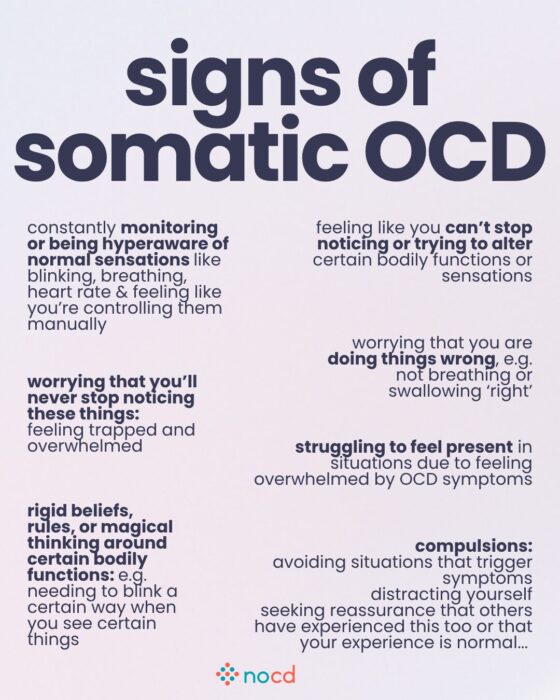
Somatic OCD is a subtype of obsessive-compulsive disorder (OCD) involving persistent, distressing awareness of automatic bodily sensations or functions, such as breathing, blinking, swallowing, heartbeat or heart rate, chewing, the movement or feeling of your tongue, bladder or bowel pressure, or itching.
You may become afraid that you will never stop noticing the sensation, that you could forget how to perform the function naturally, or that you need to closely monitor it to make sure nothing goes wrong.
But what if something is actually wrong with me?
New, persistent, painful, or otherwise concerning physical symptoms should be evaluated by a healthcare provider. If you’re worried about your breathing, heart rate, swallowing, bladder function, or another bodily process, a doctor can assess what you’re experiencing and refer you to an appropriate specialist when needed, such as a pulmonologist, cardiologist, or urologist.
An OCD specialist answers a different question: whether the ongoing attention, distress, monitoring, or need for reassurance around that bodily function is being driven by OCD.
It’s also possible for both things to be true. You may have a real physical symptom or condition and still develop an OCD cycle around noticing, checking, or trying to control it. And even when a medical evaluation does not find a physical problem, the sensation can continue to feel intense and impossible to ignore.
Why can’t I stop noticing it?
You may understand that nothing is medically wrong. You may have had an evaluation, received reassuring results, and still find yourself fixated on your breathing, blinking, swallowing, heartbeat, or another bodily sensation.
When a medical evaluation hasn’t found a physical cause that needs treatment, continued fixation may mean your attention has become locked onto the sensation.
The more you monitor a bodily function (or try to force yourself to stop monitoring it), the more important and noticeable it can seem. Brief reassurance or distraction may help for a moment, but it can also teach your brain that the sensation needs to be watched or controlled.
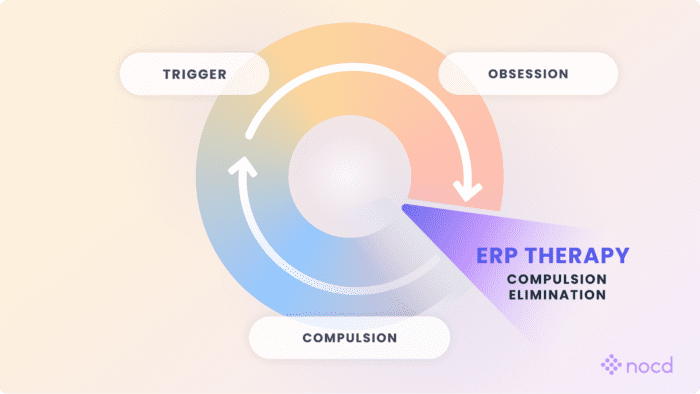
Over time, this creates a cycle: you notice the sensation, become distressed by it, try to make the awareness go away, and end up noticing it even more.
The more you monitor a bodily sensation—or try to force yourself not to notice it—the more your brain learns that it must be important. That can keep pulling your attention back to the sensation, even when there’s no medical problem that needs to be addressed.
April Kilduff, MA, LCPC, LMHC, LPC
What does Somatic OCD look like?
Somatic OCD, like all forms of OCD, involves obsessions and compulsions.
Obsessions are intrusive thoughts, feelings, urges, images, or sensations that cause distress. In Somatic OCD, they often involve becoming intensely aware of an automatic bodily function and fearing that you will not be able to stop noticing, monitoring, or controlling it.
Compulsions are mental or physical behaviors done to reduce distress or make the sensation feel manageable. In Somatic OCD, that might mean checking a bodily function, seeking reassurance, researching symptoms, avoiding triggers, or trying to distract yourself from the sensation.
Here are some examples of how Somatic OCD can show up:
| Example Obsession | Example Compulsion |
| “My breathing doesn’t feel deep enough. What if I’m doing it wrong?” | Turning on a show or scrolling on your phone to distract yourself from your breathing |
| “How often am I blinking? What if I’m blinking too much or too little?” | Counting each blink |
| “What if I forget how to swallow naturally?” | Searching online for information about how swallowing works |
| “I can’t stop noticing my heartbeat. What if something is wrong?” | Repeatedly asking someone to check if your heartbeat is normal |
| “What if I can’t stop noticing every movement I make when I chew?” | Avoiding eating with other people |
Somatic OCD can focus on many different bodily functions, but the pattern is similar: a normal sensation or automatic process becomes difficult to ignore, and compulsions become an attempt to check it, control it, or make the awareness go away.
How is Somatic OCD treated?
Somatic OCD can make automatic bodily sensations feel impossible to ignore, but it responds well to treatment.
The most effective treatment for OCD is exposure and response prevention (ERP) therapy, a specialized form of cognitive behavioral therapy (CBT). General CBT, if not tailored for OCD, can sometimes be unhelpful or even worsen symptoms.
ERP can help you gradually notice bodily sensations without checking, controlling, avoiding, researching, seeking reassurance, or trying to force the awareness to go away. For someone with Somatic OCD, that might look like:
- Allowing your breathing to feel noticeable or “wrong” without taking deep breaths to correct it
- Letting yourself blink naturally without counting or monitoring each blink
- Eating without checking whether you are chewing or swallowing “correctly”
- Noticing your heartbeat without measuring your pulse
Over time, ERP helps you learn that bodily sensations can be noticeable and uncomfortable without requiring a response. The goal is not to stop noticing your body completely. It is to stop treating the sensation like a problem that must be checked, controlled, or escaped.
ERP can make a meaningful difference. In NOCD clinical data, members treated for Somatic OCD experienced a 40% reduction in OCD severity on average.
ERP is sometimes combined with other approaches, including:
- Medication, particularly selective serotonin reuptake inhibitors (SSRIs)
- Mindfulness-based strategies
- Acceptance and commitment therapy (ACT)
Severe or treatment-resistant OCD may sometimes require higher levels of care, such as intensive outpatient programs (IOPs), partial hospitalization programs (PHPs), residential treatment, or other specialized interventions like transcranial magnetic stimulation (TMS).
Bottom line
Everyone notices bodily sensations sometimes. With Somatic OCD, the problem is not simply that you can feel your breathing, heartbeat, swallowing, or another bodily function—it’s that the awareness starts to feel urgent, threatening, or impossible to escape.
A medical provider can help determine whether there is a physical issue that needs attention. When OCD is keeping you stuck in monitoring, checking, reassurance-seeking, or avoidance, ERP can help you notice the sensation without treating it like a problem you have to solve.