


As a child with obsessive-compulsive disorder (OCD), I had fears about the safety of my loved ones. I worried about sinning or being bad. I worried about lying and being seen as immoral. Then, in my teen years, my obsessions transitioned to more age-related fears–this time, revolving around taboo topics and contamination rituals. Later, harm-based obsessions began to take hold.
It was as though, just when I would think one fear was under control, another would emerge. My brain seemed to need something new to latch onto, and my obsessions would shift from one theme to another. By “themes,” I mean the specific areas or topics that OCD fixates on, such as fears about contamination, harm, or morality. These themes can shift over time, as one obsession fades and another takes its place.
But why does this happen? OCD is driven by uncertainty, and it thrives on creating doubt. Change–whether in our lives or in how we see the world–has a major impact on OCD symptoms. Many of the people I’ve worked with often notice that their OCD worsens during times of significant life change–such as starting college, getting married, or having children. These changes bring stress, and stress, as we know, can make mental health conditions like OCD flare up—often with new themes or obsessions.
The search for control in OCD
Many people with OCD are deeply emotional and care profoundly about the people and things in their lives. But can you care too much?
No–as long as it’s manageable and within reason.
However, for some people with OCD, this deep care turns into a sense of overwhelming responsibility for others and for everything happening in the world around them. They feel the need to “fix” or prevent any perceived problem and to understand why it happened in the first place. They want to uncover the cause behind suffering.
These qualities can be strengths–being caring and thoughtful is a good thing–but when taken to an extreme, they can become unmanageable, leading to a debilitating way of life.
At its core, OCD drives an intense, heart-wrenching need to take care of everything and everyone. This all-invading sense of responsibility causes deep distress in the person with OCD. OCD demands certainty and doesn’t rest until it finds some semblance of it. Unfortunately, that leaves many individuals caught up in a constant search for something that doesn’t actually exist. It’s a perfect recipe for exhaustion and frustration.
How OCD changes focus
OCD tends to latch onto the very things that matter most to a person. It makes sense, then, that these obsessions might shift over time. As we grow and develop, our belief systems are challenged, and we evolve. We look at the world from different perspectives. We are no longer the same person that we were. This happens time and time again as we walk through life. It is inevitable.
As we change, so does OCD. The things that once tormented and debilitated you no longer have the same power. This is why I often describe OCD as cunning and creative. The disorder zeroes in on what you care about most.
At the root of OCD are doubt and uncertainty. OCD forces you to question the very things that bother you the most. Having OCD is like having your very own “build-a-bully”–but, unfortunately, without the cuteness of a Build-a-Bear store. It constantly shifts and adapts as we change. That’s why OCD content changes over time and from person to person.
What OCD can look like over a lifetime
OCD looks different for everyone. It can be very specific and unique, and it can also be elusive and vague. Some people experience very particular obsessions and compulsions, while others will say there is no specific thought, just a generalized feeling. It is important to recognize that regardless of the way that one experiences it, it is still OCD.
Below are some examples of common, more classical presentations that Alan encountered throughout various developmental timelines:
- As a child, Alan starts school. It is the first time he will be away from his mom for an extended period. While drawing shapes in class, he is suddenly overwhelmed by thoughts and images of his mom dying. He feels compelled to re-draw every shape until the thought dissipates.
- As a teenager, Alan refuses to continue in his driver’s education classes, causing tension with his parents, who expect him to learn how to drive. What they don’t know is that Alan has become consumed by the fear that he might run someone over or cause a car accident. The thought of driving triggers vivid, gruesome images of car wrecks.
- At age 18, Alan heads off to college. Despite being excited about his new chapter, he’s ashamed that he’s never been on a date before. The real source of his anxiety is even more embarrassing to him: he isn’t sure if he’s attracted to anyone. He feels guilty every time he thinks about dating, worried that he might be deceiving someone by leading them on.
- As an adult, Alan becomes a father. Though filled with nervous excitement, his joy is overshadowed by a horrifying intrusive thought: What if I sexually abuse the baby? He finds himself avoiding his son, making excuses not to change the baby’s diaper or feed him, gripped by an irrational guilt.
As these examples show, OCD can be triggered by anything at any time, and can manifest in different ways at different stages of life. But there’s good news: OCD is manageable. You can learn how to cope with the underlying core fears that are often hidden under various themes.
Ask yourself, what am I really afraid of? Many people with OCD fear being seen as bad, unlovable, or dirty. The list of potential fears is endless. But once you uncover what you’re truly afraid of, you can start addressing the symptoms that feel so overpowering.
The bottom line is that OCD wants certainty. It seeks to plant doubt in your mind about who you are and what you’re capable of. The problem is, certainty is an impossible goal. That’s why it is so important to recognize that, no matter how distressing your thoughts may seem or how strong the pull of certainty is, you don’t need to engage.
The good news is that through non-engagement with these obsessions, you can free yourself from OCD’s grip. You can manage its symptoms, no matter how they shift over time, and live a value-driven life.

Find the right OCD therapist for you
All our therapists are licensed and trained in exposure and response prevention therapy (ERP), the gold standard treatment for OCD.
Exposure and response prevention therapy for any theme of OCD
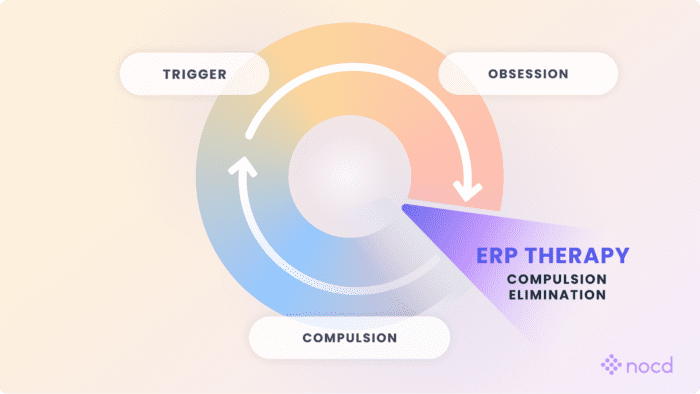
The key to breaking free from the cycle of OCD is non-engagement, and that’s where exposure and response prevention (ERP) therapy comes in. ERP is the most effective treatment for OCD. It helps you resist compulsions, which offer only temporary relief from anxiety, and teaches you to accept uncertainty–even when the thoughts, images, or urges feel extremely distressing. By resisting compulsions as a response, you retrain your brain to recognize that you are not in actual danger. The goal of ERP is to learn to manage OCD effectively and to provide long-term relief.
Regardless of the OCD subtype or the nature of the intrusive thoughts—violent, taboo, sexual, or otherwise upsetting—ERP will be effective. In most cases, people find that ERP helps their anxiety subside to the point where they no longer experience intense fears related to their thoughts on a regular basis.
That’s why it’s so important to work with a therapist who specializes in ERP. Whether you’ve experienced your particular OCD theme many times or are dealing with something new or less common, a trained therapist can tailor your treatment to your specific needs. Every person receives a personalized treatment plan when they begin ERP, designed to address their unique symptoms.
ERP therapy is an active treatment that requires full participation, including a willingness to experience discomfort and be honest with your therapist about your obsessions and compulsions–no matter how shameful or taboo they may feel. Research shows that ERP is highly effective, with about 80% of people with OCD reporting positive results, often within 12 to 25 sessions.
At NOCD, all therapists specialize in OCD and receive ERP-specific training. They deeply understand all themes of OCD and how they can switch from time to time. If you have questions or think that you may need ERP therapy for your OCD, I encourage you to learn about NOCD’s accessible, evidence-based approach to treatment.
Bottom Line
OCD may switch from one fear to another, but the disorder itself remains the same. By learning to tolerate uncertainty and resist compulsions through ERP therapy, people can find relief regardless of how their OCD changes over time.