


How Mariah Jacobsen, MS, LMHC, went from play therapy to specializing in OCD
Before joining NOCD, Mariah Jacobsen primarily treated children and adults experiencing trauma, using play therapy and EMDR. Through that work, she began seeing more clients with co-occurring obsessive-compulsive disorder (OCD). “I had some knowledge on OCD, but I really wanted to dive deeper into that work,” she says. “I found it to be so fascinating.” That curiosity led her to research OCD, and then to NOCD.
As she further explored the company, she realized it offered something she’d been missing. “I needed some more intellectual stimulation,” she says. “I wanted to take on a new challenge.” NOCD’s opportunity to specialize in OCD treatment provided just that.
Learning how wide OCD really is
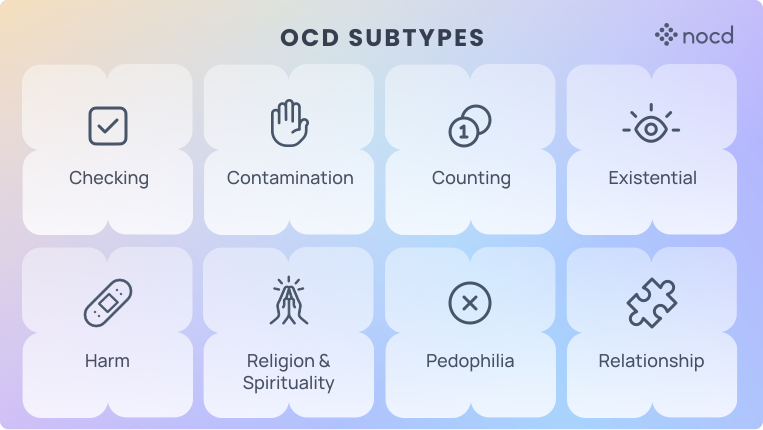
As Jacobsen went through NOCD’s training, she realized just how many subtypes OCD has and how many different ways it can affect people. “That’s been something that’s been really fascinating to me,” she says. That depth is a sharp contrast to her earlier training. In grad school and internships, she says, clinicians tend to learn about many disorders in a general way, and the detail comes bit by bit over a career. At NOCD, the training goes in depth on OCD itself, taught by leaders in the field. “Learning from the experts here has been really transformative,” she says.
Now, when she tells her former colleagues what she’s learning, they’re “utterly shocked.” They had no idea OCD could present in so many ways. Their reaction points to a larger problem: OCD is often misunderstood, and many clinicians aren’t trained to recognize it, so they miss the presentations. In fact, on average, it takes 14 to 17 years for someone with OCD to find appropriate care, and research has shown that 70% of OCD cases are misidentified.
Creativity inside the structure
As she began treating OCD with exposure and response prevention (ERP), Jacobsen was struck by how different every session is. “How OCD presents itself is so wide and varied,” she says. “There’s no session that is the same. Nobody presents the same way. It really keeps things interesting.”
That variety eased a worry she had going in. Her play therapy career was hands-on, in person, and spanned a wide range of diagnoses. She wondered what it would be like to focus on one thing every day. Would she do well at it? Would she enjoy it? Moving to specialty OCD care felt like a leap of faith, and it’s paid off. “I’ve really loved it,” she says.
She shares how ERP follows a specific path, and within that structure there’s still room to be creative, which suits a self-described “very artsy and creative person.” Members often ask whether she’s tried a particular exercise with anyone else before. “Nope,” she tells them. “You’re the first one.”
Making an impact, together
ERP’s structure also shapes the impact she has on the Members she sees. Because ERP follows “a very specific path,” she says, progress feels “so much more significant” to her as a clinician.
Her Members arrive ready to work, often after years of struggling. “They want to do these really difficult exercises because they want their life to be different,” she says. She emphasizes that treatment is shared work. “This is going to be a collaboration between you and me,” she tells them. It gives Members a sense of autonomy: they’re doing something hard because they’ve chosen it, to regain their life from OCD.
For Jacobsen, who has worked with other approaches over the years, ERP stands apart. “Doing ERP is unlike any other treatment modality I’ve ever used,” she says.
Looking for a specialty where no two sessions are the same? Explore therapist opportunities at NOCD.